
The text was short.
“How’s your schedule looking next week?” I typed to my buddy Sam. “I think we’re going to get a hatch by Sunday.”
He replied quickly: “Hatch? It’s February and it’s freezing.”
“Exactly,” I answered. “It’s the rarest of hatches here in Virginia: fishable ice.”
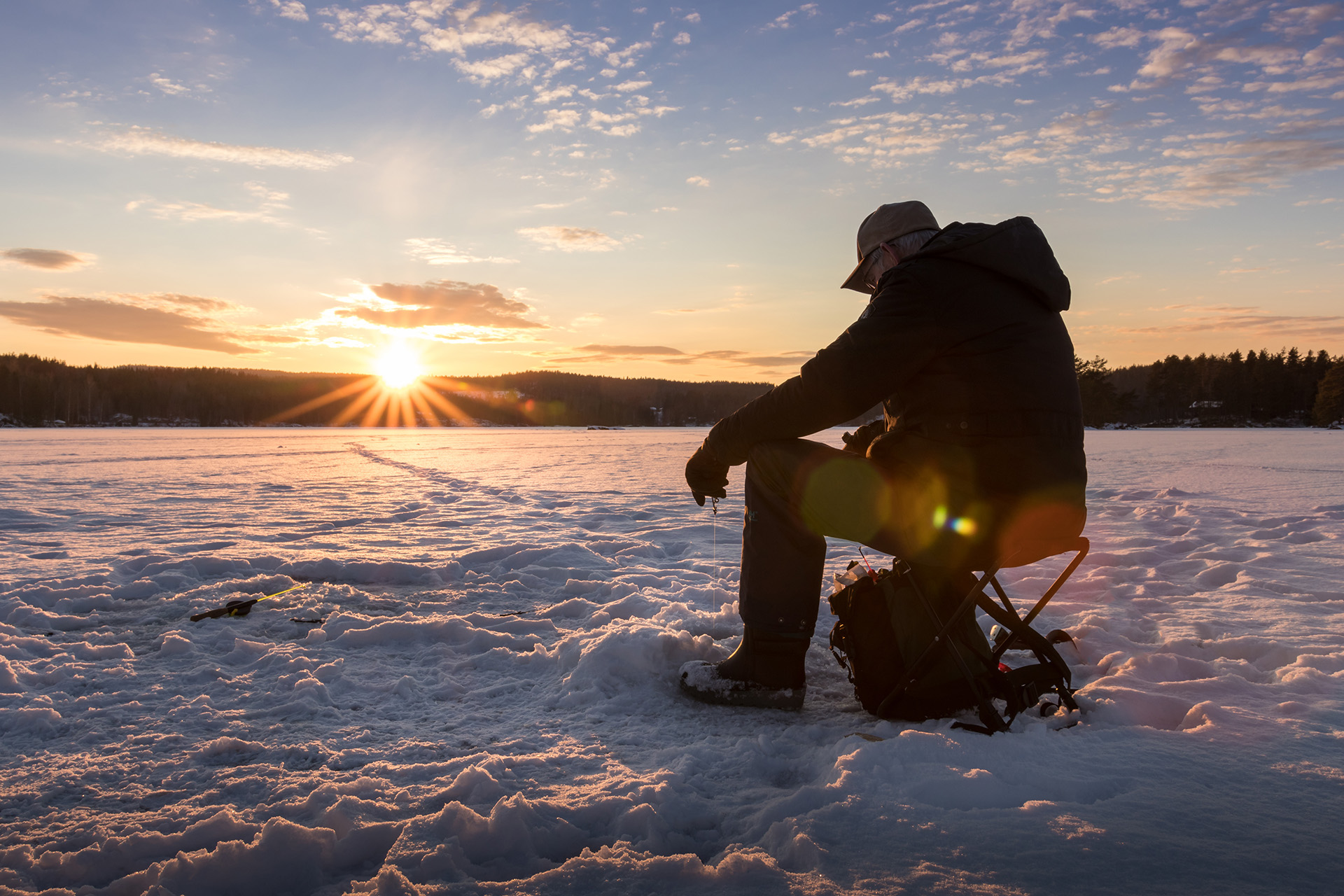
Ice fishing is an annual pastime for our friends up North. Here in the Southeast, it is a rare and fleeting thing. I hadn’t ice fished in Virginia since 2015.
I’m not complaining that I get to target trout in moving water year ‘round here in the mid-Atlantic. But when we do get the rare hard water hatch, it’s a “fun break from our regularly scheduled programming,” as a friend recently put it.
Safe for fishing
After more than a week of being buffeted by an Arctic blast — one that even saw sections of the river running through town frozen over in places — I was confident my go-to ice fishing spot would be safe for action in a couple of days.
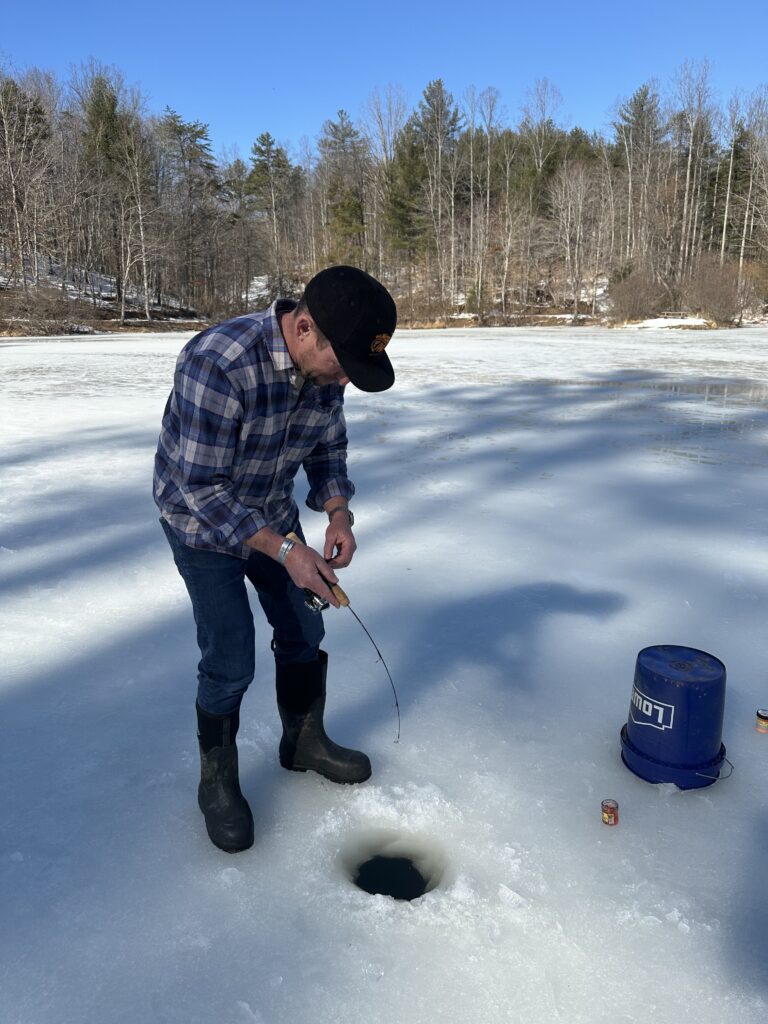
It was. I hiked the ¾ of a mile into the private pond late one afternoon to test it. I kneeled on the dock and, using a hand chisel, started chipping. It took a couple minutes to hit water. The ice was 5-inches thick. I stepped onto the pond and walked around.
No creaks. No cracks. No groans. No worries.
I went back two days later, solo, since Sam had to leave town for work. The club that owns the pond stocks it with hatchery-raised rainbow trout during the winter. Those fish can’t survive the summer, so it’s purely a put-and-take fishery the club’s members (me included) enjoy. And, because it’s privately stocked, we don’t have to adhere to the single-line restriction in place on the state’s designated put-and-take waters. That regulation makes sense for public stocked trout waters but is a big handicap when ice fishing. (Our club does have a self-designated three-trout limit.)
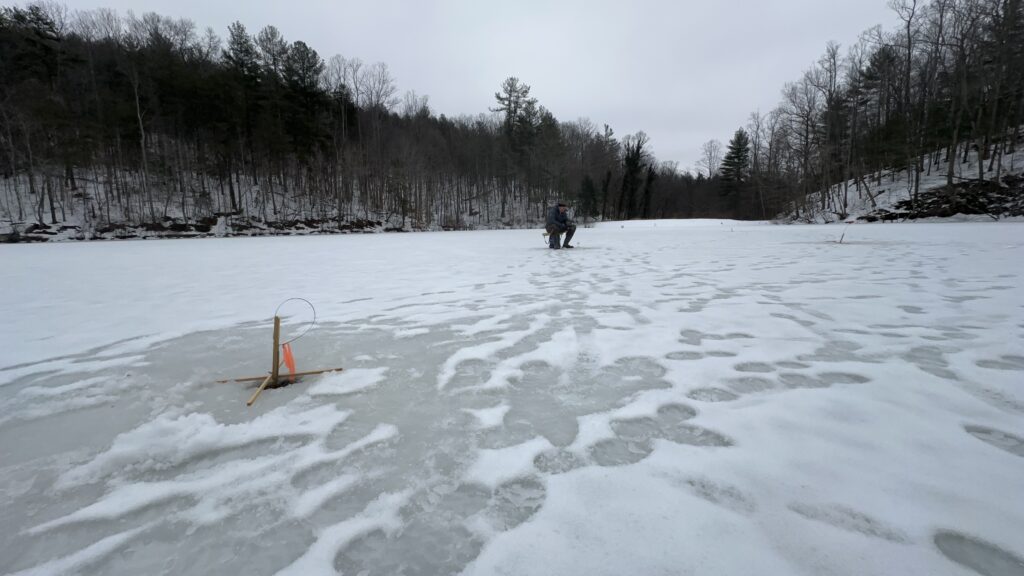
I chopped a few holes and started putting out old school tip-ups baited with PowerBait from a decades-old jar that sees the light of day only on the ice. Tip ups in place, I started working on another hole for jigging but didn’t even get the hole finished before the first tip up flag was flying.
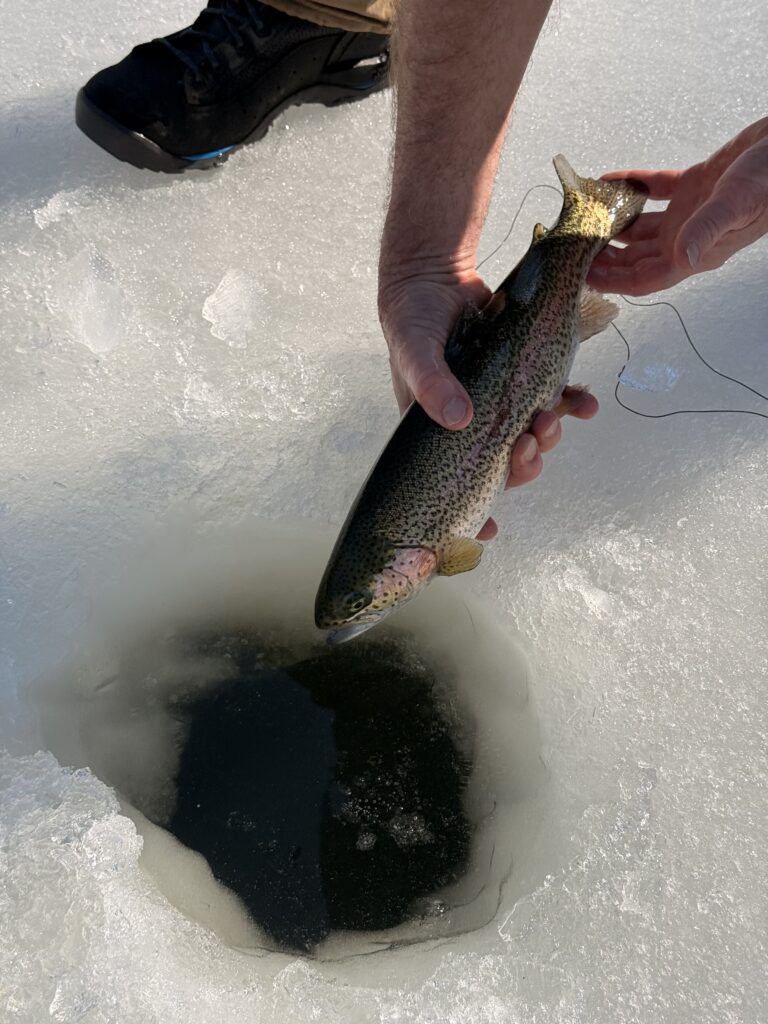
Action was fast. Over the course of 90 minutes the tip ups produced numerous strikes and three fat rainbows, the largest two about 16-inches long. The bigger ones went back, but a smaller one went onto the ice in preparation for a future appearance in smoked trout dip. When I finally started jigging, that tactic produced another small keeper.
Back for more
A few days later I convinced a friend to hike in with me. Mike isn’t a fisherman, but he and his sidekick Henry are up for just about any adventure. Henry, an exuberant chow/shepherd mix, sprinted around the frozen pond — a layer of crusty snow on top of the hard ice provided good traction for him — chasing snowballs while I got us set up.
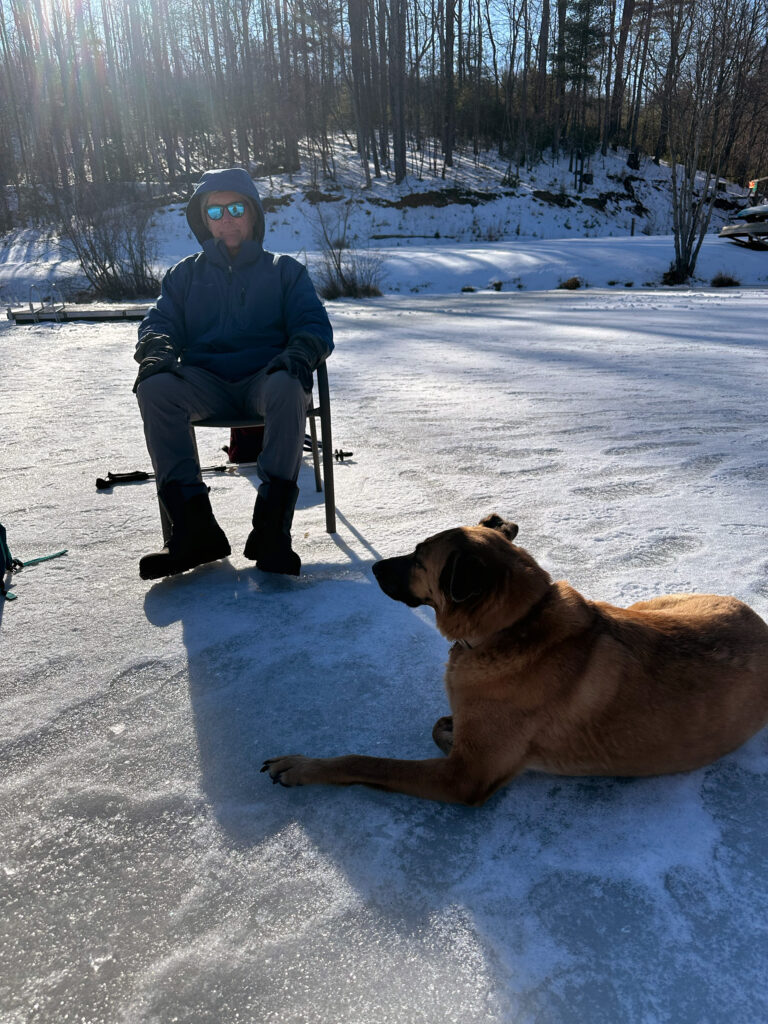
The fishing action was even better than on the first trip. We caught several nice trout, all but a couple of which went back into the pond. Henry had a blast, drinking water from the holes and pawing curiously at the keepers on the ice.
I texted a few pictures to Sam who recently returned to town. “Warm weather and busy work schedule on the horizon,” I wrote. “If you want to go, it’s Tuesday or nothing.”
So, there we were on Tuesday afternoon. The cold snap finally broke and temperatures topped 60 degrees that afternoon. Action was slow but tip ups and jigging got us a few fish, including a couple topping 15 inches. They all quickly went back into the holes from which they emerged.
The ice was still plenty thick, but the surface was sloppy. The pond would probably be safe to fish for another day or two, but this was it for us.
As we hiked out, the talk quickly turned from reflecting on our brief ice fishing diversion to what lay ahead, and we even made plans to float a local tailwater in a couple weeks, throwing streamers for big wild browns.
That evening, I cleaned the ice fishing gear and wistfully placed it back in the bin where it lived since its last use more than a decade ago. There it will remain until the next hard water hatch, whenever that may be.
Hard water fishing tips:
When you live in rare ice country, it doesn’t make sense to have a full arsenal of gear like our friends in the North Country.
I bought most of my ice gear one January day probably 25 years ago when the forecast for ice looked promising. I started with a few old school tip-ups and a short, Tweety Bird spincast kid fishing rod and reel combo for jigging. Later I added a couple of inexpensive ice fishing-specific spinning rod/reel combos that were on deep discount at a local sporting goods store after years of balmy, ice-free winters.
A hand chisel can chop holes and work well in moderately thick ice, but a hatchet is much faster. (Also, more dangerous. Be careful!) There’s no need to invest in an ice auger.
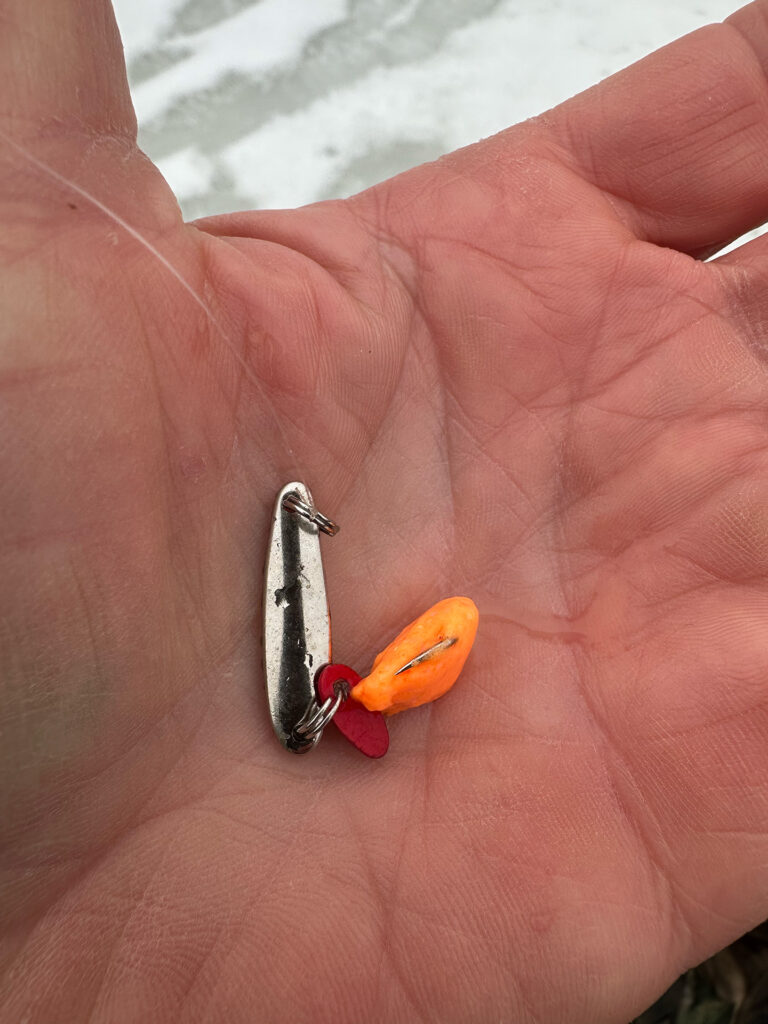
A small Swedish Pimple spoon was my dad’s favorite ice fishing jig when he was growing up in South Dakota, and it works as well now as it did 70 years ago. I usually add a little bait sweetener, either a mealworm or PowerBait.
When targeting stocked trout with tip ups, I use small circle hooks or little ice jigs, usually baited with PowerBait or meal worms. If I’m targeting crappies or perch I’ll use minnows. Tiny jigs with meal worms work well for bluegills.
How thick does ice have to be for safe fishing? There’s no exact answer. A good rule of thumb is four or five inches, but the type of ice makes a difference. Even when small ponds are safe, larger lakes can be sketchy. It’s also typically easier to locate fish on smaller ponds so that’s where I focus my efforts.