Search results for “colorado river basin”
A lot of college internships have been cancelled this year because of the global pandemic. Bryce Larson, a senior at University of Colorado, Colorado Springs, found herself in that boat but determined to explore her options. Her tenacity paid off by landing a Trout Unlimited summer internship working on a risk assessment for native Bonneville…
New leadership and investments in people reflect growing federal partnerships and project funding across region Contact: DENVER – Today, Trout Unlimited (TU) announced a series of new investments in its people to accommodate the growing number of innovative partnerships across the Rocky Mountains. Over the last decade, TU has secured roughly $133 million in funding partnerships to…
FOR IMMEDIATE RELEASE: May 27, 2014 Contact: Russ Schnitzer: (970) 309-0285 (West) Jeff Hastings: (608) 606-4158 (Midwest) Gary Berti: (304) 704-2731 (East) Steve Moyer: (703) 284-9406 (National) Its a new and better day for fisheries conservation on the farm WASHINGTON, D.C.Trout Unlimited saluted USDA Secretary Vilsacks announcement in Michigan today that the Natural Resources Conservation…
New leadership and investments in people reflect growing federal partnerships and project funding across the region.
Colorado’s namesake river is in trouble. With the ongoing megadrought, climate change and many straws dipping in to satisfy a thirsty, growing population, agriculture and many other uses, fishing and the river’s ecological health are in jeopardy. Luckily, Trout Unlimited and our partners near the headwaters of the Colorado River are working together to help…
As infrastructure to support natural gas extraction expanded across the Appalachians over the past decade, the Delaware River Basin remained untouched as the group responsible for the coordinated management of the watershed considered the practice. Now, after years of uncertainty, a vote by the Delaware River Basin Commission has formalized a ban on high-volume hydraulic fracturing — often called “fracking” — in the basin. In a special business meeting on Feb. 25, 2021, commissioners…
These are the dog days of summer.
Trout Unlimited Statement Dec. 15, 2015 Contact: Scott Yates, director, TU Western Water and Habitat program, syates@tu.org, (307) 349-0753 Randy Scholfield, TU director of Communications, Southwest region, rscholfield@tu.org, 720-375-3961 Trout Unlimited praises new Natural Resources Investment Center (Washington, D.C.) — Interior Department Secretary Sally Jewell unveiled today, at the White House Roundtable for Water Innovation,…
FOR IMMEDIATE RELEASE Dec. 21, 2016 Contact: Drew Peternell, (303) 204-3057, dpeternell@tu.org Matt Rice, (803) 422-5244, mrice@americanrivers.org Paul Bruchez, (907) 531-2008, reedercreekranch@gmail.com Colorado River restoration project secures $8 million grant NRCS award a huge boost for ambitious project to restore threatened river (Kremmling)The U.S. Department of Agricultures Natural Resources Conservation Service (NRCS) today announced $7.75…
Trout Unlimited and the Federation of Fly Fishers identified potential Native Fish Conservation Areas (NFCAs) in the Upper Snake River Basin above Hells Canyon Dam. NFCAs are watersheds where management emphasizes proactive conservation and restoration for long-term persistence of native fish assemblages while allowing for compatible uses. This report describes the methods and results of…
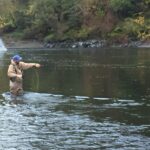
TU’s Tim Frahm swinging on the Klamath River near Weitchpec. The legendary Klamath River is the third most productive watershed for salmon and steelhead on the West Coast, after only the Columbia and Sacramento Rivers systems. The Klamath is also Ground Zero for one of the most challenging water conflicts in U.S. history. Trout Unlimited’s…
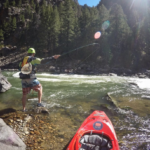
By Scott Willoughby They call it Fisherman’s Nightmare. And as scare tactics go, it’s as accurate as it is effective. Floating into the chaotic jumble of rocks and water that serves as sentinel to the Colorado River’s daunting Gore Canyon, it’s easy to imag ine how the rapids earned their name. Dropping precipitously from the…
FOR IMMEDIATE RELEASE January 14, 2015 Contact: Scott Yates, (Upper Columbia, Gunnison River Basins), (307) 349-0753 Warren Colyer, (Bear, Blackfoot River Basins), (435) 881-2149 Randy Scholfield (TU communications), (720) 375-3961 Steve Moyer (National), (703) 284-9406 Trout Unlimited hails new, better day for fisheries conservation on the farm NRCS-funded projects deliver benefits for fish, farm and…
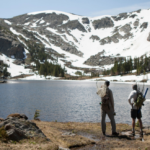
Public Land: Rocky Mountain National Park. Established Jan. 26, 1915, Rocky Mountain National Park was the 10th recognized national park in the United States. It is the best place in the Lower 48 for visitors to experience alpine landscapes and tundra. Driving in from Denver (just two hours away) allows for visitors to see numerous…
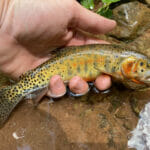
Colorado River cutthroat trout (Oncorhynchus clarkii pleuriticus) Species status and summary: The Colorado River cutthroat trout (CRCT) historically occupied most cool water habitats of the Colorado River watersheds in Colorado, southern Wyoming, eastern Utah, extreme northwestern New Mexico and northeastern Arizona. Currently, however, Colorado River cutthroat trout occupy approximately 16 percent of their historic range, primarily…
As TU founder Art Neumann famously stated, “Take care of the fish and the fishing will take care of itself.” But we’re predominantly fly fishing, after all. So what about the bugs? Who’s looking after them? As it turns out — on the Colorado River below Glen Canyon Dam, anyway — the U.S. Geological Survey is doing just that. It may mark the dawn…
Editor’s note: Water in the West is at a defining moment with severe drought and climate change upending decades of management practices and creating the need to find common ground so all users can benefit. Read or listen to learn more about how conflict can lead to collaboration in the second installment of our Western Water 101…
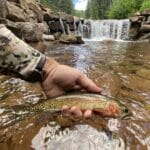
By pack mule and on foot, the Forest Service and Colorado Parks and Wildlife members went in to save the previously thought-to-be extinct lineage. Less than 100 individual trout were removed and taken to the Durango fish hatchery for safekeeping and possible brood stock development.
1/04/2005 For immediate release For more information: Drew Peternell 303-440-2937 CONTROVERSIAL PROPOSED GUNNISON RIVER HYDOELECTRIC PROJECT LOSES ITS WATER RIGHTS TU: AB Lateral Project would have damaged two watersheds in western Colorado Boulder, CO A proposed hydroelectric power project which could have taken more than 1,000 cfs of water from the Gunnison River has relinquished…
By Rob Catalanotto, Laura Ziemer and Steve Moyer After weeks of negotiations, the US Senate and House recently approved a massive appropriations bill to fund the government through fiscal year 2020. The deal averted a government shutdown, which was set to take effect on December 20 had Congress had not taken decisive action. TU field staff…